
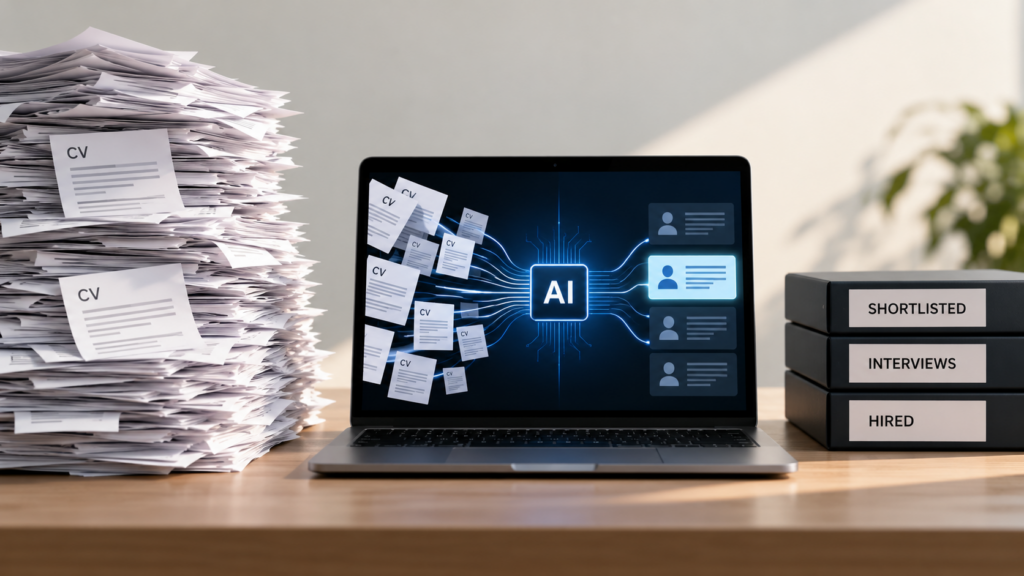
AI in recruitment was supposed to revolutionise hiring, making the process faster, smarter and more efficient. But as artificial intelligence transforms how candidates apply for jobs and employers screen applications, an uncomfortable question is emerging: are we improving recruitment or simply automating the chaos?
The recruitment industry is experiencing one of its most significant technological transformations in decades.
AI-powered recruitment tools promise faster candidate screening, improved hiring decisions and reduced administrative workloads.
Meanwhile, job seekers are embracing AI technology to optimise CVs, generate cover letters, identify opportunities and automate job applications.
On the surface, this sounds like progress.
But look a little closer, and something interesting is happening.
One category of AI technology is making it easier to generate thousands of job applications. Another category is selling employers the technology required to manage and filter those applications.
And somewhere in the middle, recruiters are overwhelmed, candidates are frustrated, and organisations are investing in increasingly sophisticated recruitment technology.
Welcome to the AI recruitment arms race.
How AI in Recruitment Is Changing the Job Application Process
Traditionally, applying for a job required candidates to invest time researching organisations, tailoring applications and demonstrating why their experience aligned with a particular opportunity.
Today, AI job application tools can complete significant portions of that process in seconds.
Candidates can generate multiple versions of their CV, produce personalised cover letters and submit applications across numerous platforms with minimal manual intervention.
Used appropriately, these technologies can be incredibly valuable.
They can help candidates communicate their experience more effectively, identify suitable opportunities and reduce repetitive administrative work.
However, problems arise when technology prioritises application volume over relevance.
A candidate who previously applied for ten carefully selected positions may now submit dozens or even hundreds of applications with considerably less effort.
Multiply that behaviour across thousands of job seekers, and the consequences for employers become apparent.
More applications do not necessarily mean more qualified candidates.
In fact, increasing application volumes can make identifying genuinely suitable professionals significantly more difficult.
And this is where the recruitment technology paradox begins.
The AI in Recruitment Paradox: Are We Creating More Problems?
As employers struggle with increasing application volumes, recruitment technology providers are introducing increasingly sophisticated AI screening solutions.
These platforms promise to:
- Automatically review and shortlist applications.
- Identify relevant skills and experience.
- Reduce recruiter screening workloads.
- Improve candidate matching.
- Accelerate hiring decisions.
These capabilities can deliver genuine operational benefits when implemented appropriately.
But consider the wider recruitment ecosystem.
One side of the technology industry makes it easier for candidates to generate and submit applications at scale. The other side sells employers the technology needed to manage those applications.
The result is an increasingly automated process on both sides.
Candidates use AI to apply.
Employers use AI to screen.
Candidates optimise their applications for automated screening.
Employers introduce more sophisticated filtering systems.
And the cycle continues.
The technology itself isn’t necessarily the problem.
The concern is whether recruitment is becoming an escalating competition between automated systems rather than a process designed to identify and engage suitable people.
Are we genuinely improving recruitment, or are we creating an increasingly expensive technological arms race?
AI Recruitment Tools: Efficiency Versus Effectiveness
Having worked in recruitment and executive search for more than two decades, I’ve seen numerous technologies promise to revolutionise hiring.
Some have delivered significant improvements.
Others have simply introduced additional complexity.
One of the biggest mistakes organisations make is confusing efficiency with effectiveness.
Efficiency measures how quickly a process operates. Effectiveness measures whether it delivers the intended outcome.
An AI recruitment platform might screen 1,000 applications in minutes.
But that achievement means relatively little if the organisation still struggles to identify the right candidates.
Similarly, a job seeker might submit 200 applications using AI.
But if those applications generate no meaningful conversations or interviews, has the technology genuinely improved their job search?
Recruitment success should not be measured solely by application volumes, screening speed or automation rates.
It should be measured by the quality of hiring decisions, candidate experience, recruitment outcomes and long-term organisational value.
Processing more applications doesn’t automatically mean making better hiring decisions.
The Hidden Challenges of AI in Recruitment for Employers
For employers, the growing use of AI-generated applications creates several operational challenges.
1. Increasing Application Volumes
Recruitment teams may receive significantly more applications than previously, particularly for highly visible or remote positions.
This can increase screening complexity even when AI-assisted recruitment systems are available.
2. Reduced Differentiation Between Candidates
AI-generated CVs and cover letters frequently use similar terminology, structures and competency descriptions.
When large numbers of candidates present themselves using comparable language, identifying meaningful differences becomes more challenging.
3. Greater Dependence on Recruitment Technology
Organisations may feel compelled to invest in increasingly sophisticated applicant tracking systems and AI screening capabilities simply to manage incoming application volumes.
However, technology investments should address genuine recruitment requirements rather than compensate for poorly designed hiring processes.
4. Candidate Experience and Screening Risks
Overreliance on automated screening can create additional challenges.
Without appropriate oversight, organisations risk overlooking relevant candidates, reinforcing existing selection biases or creating recruitment processes that lack transparency.
AI should support professional judgement, not eliminate it.
How AI-Generated CVs Are Changing Job Search Strategies
The challenges are equally significant for job seekers.
Many professionals believe that increasing their application volume will automatically improve their chances of securing interviews.
Unfortunately, today’s recruitment market is more complicated.
A strong CV and optimised LinkedIn profile remain important, but they are no longer sufficient as a complete job search strategy.
Candidates also need to understand:
- How employers identify and evaluate talent.
- Which organisations are actively hiring.
- How to approach decision-makers directly.
- How to build relevant professional networks.
- How to position their experience against changing market requirements.
- How to measure and adjust their job search activity.
Applying for more jobs is not necessarily a better strategy. Applying more intelligently is.
AI can support that process, but it cannot replace market understanding, professional relationships or strategic decision-making.
A candidate who relies entirely on automated applications may be increasing activity without improving outcomes.
And that distinction matters.
Automating an ineffective job search strategy doesn’t suddenly make it effective. It simply allows you to execute that ineffective strategy faster.
For candidates, investing in professional CV writing, LinkedIn optimisation and a structured job search strategy can help improve how they position themselves in an increasingly competitive employment market.
The Ethical Questions AI Recruitment Technology Must Address
The rapid development of AI recruitment technology raises important questions about responsibility.
Should technology providers encourage candidates to automate applications without considering the consequences for employers?
Should organisations rely heavily on automated screening without understanding how those systems evaluate candidates?
And should the recruitment technology industry be doing more to address the unintended consequences of its products?
These are not arguments against innovation.
They are arguments for responsible innovation.
Recruitment technology should improve the connection between employers and suitable candidates.
It should not simply accelerate the movement of increasingly large volumes of information between competing automated systems.
The wider impact of artificial intelligence on employment is already attracting significant attention.
The World Economic Forum’s Future of Jobs Report 2025 examines how technological change, including AI, is reshaping labour markets, workforce requirements and organisational strategies.
For recruitment professionals, this reinforces the importance of adapting hiring practices to changing market conditions rather than relying solely on additional automation.
How Employers Can Improve Their AI Recruitment Strategy
The solution isn’t to abandon AI recruitment technology.
It’s to become more strategic about how it is implemented.
Audit the Recruitment Process Before Buying More Technology
Before introducing additional AI tools, organisations should examine their existing recruitment strategy.
Where are the genuine bottlenecks?
Are job descriptions attracting suitable applicants?
Are recruitment teams using appropriate sourcing channels?
Is the organisation overly dependent on reactive applications rather than proactive talent identification?
Technology should address clearly defined problems.
Measure Recruitment Quality, Not Just Speed
Recruitment performance should be evaluated using meaningful indicators, including:
- Quality of shortlisted candidates.
- Interview-to-offer conversion rates.
- Candidate experience.
- Time to productive contribution.
- Hiring-manager satisfaction.
- Retention and longer-term hiring outcomes.
Maintain Human Oversight in AI Recruitment
AI can support candidate identification, screening and administration.
However, effective recruitment still requires judgement, contextual understanding and professional engagement.
Particularly for specialist and senior appointments, technology should complement experienced recruiters rather than replace the expertise they provide.
Invest in Proactive Talent Acquisition
Organisations should not rely exclusively on incoming applications.
Targeted talent mapping, direct candidate engagement, professional networks and market intelligence remain important components of an effective recruitment strategy.
The most successful recruitment approaches will combine technology with a clear understanding of the talent market.
The Future of AI in Recruitment: Smarter Hiring or More Automation?
Artificial intelligence will continue to influence how organisations recruit and how candidates approach the employment market.
That transformation creates genuine opportunities.
But progress should not be measured by how much of the recruitment process we can automate.
It should be measured by whether technology improves recruitment outcomes.
If candidates are submitting more applications but receiving fewer meaningful responses, something isn’t working.
If recruiters are processing more CVs but struggling to identify suitable talent, something isn’t working.
And if organisations are continually purchasing new technology to manage the consequences of existing technology, perhaps the industry needs to reconsider its priorities.
The future of recruitment shouldn’t be about who has the most sophisticated automation.
It should be about who can combine technology, market intelligence and human expertise most effectively.
Because ultimately, recruitment is not about processing applications.
It’s about connecting the right people with the right opportunities.
And no amount of automation should make us forget that.
Are We Just Automating the Chaos?
The recruitment industry is entering a period of significant transformation.
AI recruitment tools will continue to evolve.
Job seekers will continue adopting technology to improve their applications.
Employers will continue investing in automated recruitment systems.
But the real question is whether these developments will deliver better outcomes.
Are we genuinely making recruitment smarter, or are we simply creating more technology to manage the consequences of technology?
Because if we’re using AI to create more applications, more screening, more filtering and more frustration, perhaps we’re not revolutionising recruitment at all.
Perhaps we’re just automating the chaos.
And that should concern everyone working in our industry.